The Three Types of Logos

There are only three types of logotypes, and understanding them helps explain why some brands feel timeless while others look perfectly of their era.
I created this illustration to show what I call the Traditional, Contemporary, and Iconic logotypes. Let's go through them one by one.
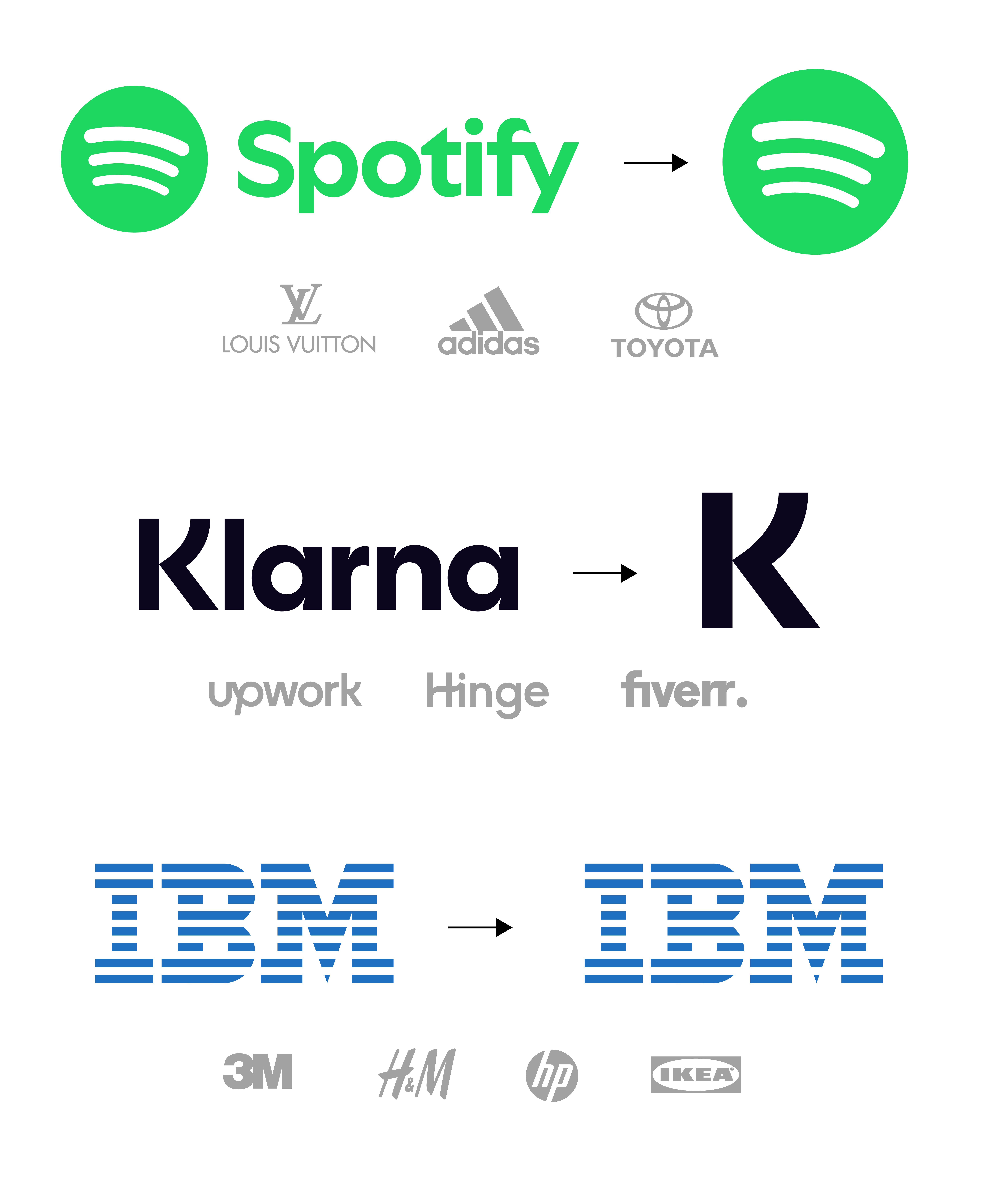
1. The Traditional (Spotify)
This type of logo has two main parts: the wordmark and the icon. The wordmark is the text-only representation of the brand name, while the icon is a separate visual element that can be abstract, letter-based, or illustrative.
Spotify is a great example. The brand's wordmark spells out its name in a friendly, rounded typeface, and its green circle with three curved lines has become instantly recognizable. The two elements can work together or separately, which gives the brand flexibility across different touchpoints, from app icons to billboards.
Many classic brands follow this approach. Louis Vuitton, Adidas, and Toyota, for instance, all use a combination of symbol and name to strengthen recognition and versatility.
2. The Contemporary (Klarna)
The next category takes a more minimal approach. A Contemporary logotype is often just a wordmark, but it includes a small twist: its "icon" is usually a shortened or cropped version of the full logo.
Klarna's bold "K" demonstrates this perfectly. The brand doesn't create a separate symbol but instead uses part of its wordmark as a standalone mark. This keeps the identity simple and cohesive while maintaining flexibility.
This style suits modern, digital-first brands. With limited space on mobile screens and social platforms, it makes sense to use one clear typographic system. Brands like LinkedIn, Upwork, Hinge, and Fiverr have embraced this approach, relying on typography alone to stay recognizable across different digital contexts.
3. The Iconic (IBM)
The third and final type is the Iconic logotype. This is the simplest and often the most enduring style, where the name itself becomes the symbol. Short, memorable names---often abbreviations---work best here because they can stand alone without any supporting graphics.
IBM is the perfect example. Its blue-striped letters are distinctive and instantly recognizable. The logo doesn't need an extra symbol; the design itself carries the full identity. It was actually designed in 1958 and has stayed the same since then.
Other examples include 3M, H&M, HP, and IKEA. These brands have short, strong names that would only be diluted by additional imagery. When the name itself is iconic, the strength of the brand comes from clarity and consistency.
In Summary
The three types of logotypes---Traditional, Contemporary, and Iconic---represent more than just different visual styles. They reflect how brands think about communication and identity.
The Traditional balances a symbol with a wordmark. The Contemporary merges them into one. The Iconic transcends both, relying on pure simplicity.
As brands evolve, they often move along this spectrum, simplifying and refining as they adapt to new platforms and new ways people experience them in a digital world.